Logistics

How many Euro Pallets fit in a 20ft Container?

Read the complete guide below.

Launch 3D Loader

The Short Answer

The maximum capacity for standard Euro pallets (1200mm x 800mm) in a 20ft container is 11 Pallets on the floor. If the cargo is stackable and under the weight limit, you can double-stack for a total of 22 Pallets. However, strict weight limits (approx 25,000kg) often make double-stacking difficult for heavy goods.

The "11 Pallet" Floor Plan

The Euro Pallet (EPAL) measures exactly 1200mm x 800mm (approx 47.24" x 31.5"). A standard 20ft container has internal dimensions of roughly 5.9m length and 2.35m width.

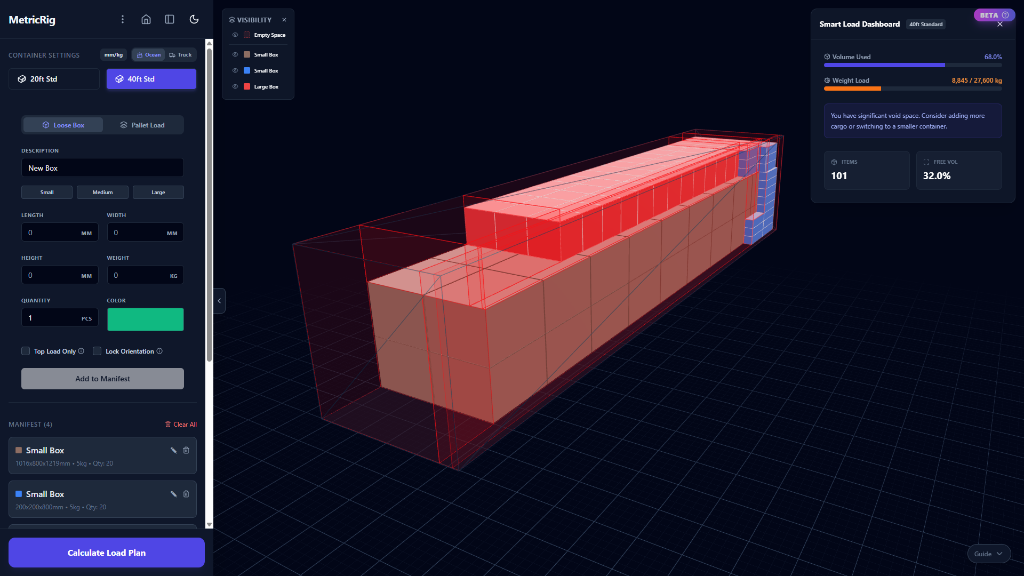
To fit 11 pallets, you cannot simply load them all straight in. You must use a staggered layout:

  • Row 1-7: 7 pallets placed lengthwise (the 1200mm side running parallel to the container length).
  • Row 8: 4 pallets placed widthwise (turned 90 degrees).

This specific configuration is tight. The internal width is ~2350mm. Two pallets side-by-side placed lengthwise (800mm + 800mm = 1600mm) leaves plenty of room. However, placing them widthwise (1200mm) allows for optimal density at the back.

Warning: Some "heavy duty" pallets have overhang. If your cargo overhangs the pallet by even 1 inch, you will drop from 11 pallets to 9 or 10.
Simulate Pallet Layout (3D)
Privacy First • No Login Required

Case Study: The "IKEA Effect"

Why did IKEA become a billion-dollar giant? Because they declared war on "Shipping Air".

In the 1950s, IKEA realized that shipping fully assembled tables meant they were paying to ship 90% air volume. A standard 20ft container costs roughly $3,000 - $5,000 to ship from Shanghai to Los Angeles.

"If you can fit 10 assembled sofas in a container, each sofa costs $500 to ship. If you can flat-pack them and fit 100 sofas, each sofa costs $50 to ship. That $450 difference is your entire profit margin."

The Euro Pallet Problem: The Euro Pallet (1200x800) is designed for European trucks, not Global ISO Containers. This mismatch wastes about 8-12% of the floor space in a 20ft container. If you are shipping low-value goods (like tissue paper or cheap furniture), this 10% waste is fatal.

The "Pinwheel" Solution

Advanced logistics planners use a "Pinwheel" pattern. Instead of loading all pallets straight, they load some sideways and some lengthwise to interlock them.
Standard Load: 11 Pallets.
Pinwheel Load: Still 11 Pallets (in a 20ft), BUT it creates tighter stability. In a 40ft container, pinwheeling can sometimes squeeze in a 25th pallet depending on the exact internal overhang.

The Weight Bottleneck

While geometry might suggest you can double-stack to 22 pallets, gravity often disagrees. The max payload of a 20ft container is typically around 24,000 kg to 28,000 kg (depending on the shipping line).

If you have 22 pallets, each pallet can only weigh roughly 1,100 kg.
If you are shipping liquids, metal parts, or dense machinery, you will hit the weight limit long before you fill the volume. In these cases, you might ship 11 floor-loaded pallets and leave the upper space empty, simply because the container cannot legally carry more mass.

MetricRig Partner

Recommended:Get $30 Off your first order! Source industrial equipment and warehouse supplies from verified global manufacturers.

Get $30 Off at Alibaba

Euro (EPAL) vs Standard US Pallets

Confusing pallet types is the #1 cause of "Ghost Cargo" (cargo that gets left behind at the dock).

  • Euro Pallet: 1200mm x 800mm. Fits 11 in a 20ft.
  • Standard US Pallet: 40" x 48" (1016mm x 1219mm). Fits 10 in a 20ft (typically).
  • ISO Pallet: 1200mm x 1000mm. Fits 10 in a 20ft.

If you calculate for Euro pallets but your supplier shows up with Standard US pallets, you will physically fail to load the last pallet. Always request a "Specification Sheet" from your overseas supplier before booking the container.

MetricRig Partner

Recommended:Get $30 Off your first order! Source industrial equipment and warehouse supplies from verified global manufacturers.

Get $30 Off at Alibaba

Why Not Use a 40ft?

A 40ft container fits 24-25 Euro Pallets.
20ft Capacity: 11 Pallets.
40ft Capacity: 24 Pallets (Widthwise loading allows more efficiency).

Mathematically, a 40ft container is not just "double" a 20ft; it is slightly more efficient for Euro pallets. You get +2 bonus pallets of capacity compared to two 20ft containers (11 + 11 = 22 vs 24).

Cost Analysis: A 40ft container is rarely 2x the price of a 20ft. It's usually 1.4x - 1.6x. Therefore, if you have more than 11 pallets, it is almost always economically superior to upgrade to a 40ft rather than shipping one 20ft + LCL (Less than Container Load) for the overflow.

Pro Tips for Loading

Use Anti-Slip Sheets

If double-stacking, place a friction sheet between the pallet layers. Containers experience up to 4G of force during crane movements. Without friction sheets, the top layer will slide and crush the door.

Check Door Height

A standard 20ft door is ~2.28m high. If your double-stacked pallets are 1.2m each (2.4m total), they will physically not fit through the door, even if they fit inside the ceiling. Always measure the door aperture, not the internal ceiling height.

Don't Guess. Visualize.

Stop using pen and paper. Use our 3D Container Engine to see if your cargo fits before you book.

Launch 3D Loader

Frequently Asked Questions

Almost impossible with standard loading. Some shippers claim 12-14 if you overhang pallets or use specialized 'wide' containers (pallet-wide), but in a standard ISO 20ft container, 11 is the hard geometric limit.
20ft High Cubes exist but are rare. They add height (perfect for tall pallets) but do not change the floor area, so the limit remains 11 pallets on the floor.
Yes, you can fit ~20-30% more product if you 'floor load' loose boxes (no wooden pallets). However, the labor cost to unload 500 loose boxes by hand is astronomical compared to forking out 11 pallets in 15 minutes.
Yes, for international shipping (ISPM 15). All wooden pallets must be heat-treated and stamped. If you use non-compliant wood, customs will reject the entire container at the port of entry.

Disclaimer: Container dimensions vary slightly by manufacturer. Always verify exact internal dims with your carrier.

Related Topics & Tools

What Is Dimensional Weight? Simple Explanation for Beginners

Dimensional weight (also called DIM weight or volumetric weight) is a pricing method that charges you based on the space your package takes up in a delivery vehicle — not just how heavy it is. The formula is: DIM Weight = (Length x Width x Height in inches) / 139 for FedEx and UPS domestic shipments. You are always billed for whichever is greater — actual weight or DIM weight. A 12x12x12 inch box that weighs only 3 lbs has a DIM weight of 13 lbs, so you pay for 13 lbs. Use the free MetricRig DIM Weight Rig at /logistics/dim-rig to calculate billable weight instantly.

Read More

Container Utilization Rate: What It Is and How to Improve It

Container utilization rate measures the percentage of a container's usable volume or weight capacity that is actually filled with cargo on a given shipment. The formula is: Utilization Rate = (Actual Cargo CBM / Usable Container CBM) x 100. A standard 20-foot dry container has approximately 25–26 CBM of usable volume; a 40-foot high-cube offers approximately 76 CBM. Most logistics managers target a volume utilization rate of 85% or higher to keep per-unit freight costs competitive — below 70%, you are effectively paying for empty air, and below 60%, the economics of FCL versus LCL typically favor consolidation instead. Weight utilization is a secondary constraint that matters primarily for dense cargo like machinery, metals, and liquids.

Read More

Best Free 3PL Cost Calculators for Ecommerce in 2026

Third-party logistics (3PL) pricing is notoriously complex — combining receiving fees, storage fees, pick-and-pack fees, outbound shipping rates, and a long tail of accessorial charges that vary by provider. The best free 3PL cost calculators in 2026 help ecommerce operators model total fulfillment cost per order, compare in-house versus outsourced fulfillment economics, and estimate warehouse space requirements before committing to a 3PL contract. Most paid 3PL comparison platforms require account creation or broker relationships; the tools listed here are genuinely free with no login, no data submission, and instant output.

Read More

Small Parcel vs LTL Cost Threshold Guide

The break-even threshold between small parcel (FedEx/UPS) and LTL freight typically falls between 150 and 200 lbs of actual or billable weight on domestic US shipments, though dimensional weight, delivery zone, and service requirements can shift this line significantly in either direction. Below 150 lbs, small parcel is almost always cheaper when accounting for LTL's minimum charges ($75 to $150 per shipment), accessorial fees, and transit time penalties. Above 200 lbs — especially for dense, uniform goods shipping to Zones 2 through 5 — LTL frequently wins on total landed freight cost. Use the MetricRig DIM Weight Rig (metricrig.com/logistics/dim-rig) to calculate your billable weight under FedEx and UPS divisors before making the mode decision, since dimensional weight can make a light-but-bulky shipment far more expensive via parcel than its actual weight suggests.

Read More

C-TPAT Program Cost and Benefits for Importers

C-TPAT (Customs-Trade Partnership Against Terrorism) is a voluntary CBP supply chain security program that certifies importers, carriers, brokers, and other trade partners as low-risk entities in exchange for expedited cargo processing and reduced CBP examination rates. The direct cost to apply and maintain C-TPAT status is relatively low — typically $5,000-$20,000 in first-year compliance costs and $3,000-$8,000 annually to maintain — but the program's real financial value lies in reduced examination rates, priority processing during port congestion, and preference in CBP's Automated Targeting System scoring. Importers who ship high-frequency, time-sensitive cargo through congested US ports can realize $50,000-$200,000+ in annual value from reduced examinations and demurrage savings alone. Use the free Landed Cost Calculator at metricrig.com/logistics/landed-cost to model examination cost risk in your existing import program.

Read More

How Many Euro Pallets Fit in a 40ft Container? (2026 Guide)

A standard 40-foot high cube (40HC) container fits 25 Euro pallets in a straightforward two-row block configuration, or up to 30 Euro pallets using an optimized alternating loading pattern that takes advantage of the Euro pallet's 1,200 × 800mm footprint relative to the container's 2,350mm internal width. Standard-height 40ft containers fit the same floor count but restrict cargo height to approximately 2.20m per pallet versus 2.50m in the high cube. The 40HC has an internal length of 12.03m (39 feet 5 inches), an internal width of 2.35m (7 feet 8 inches), and an internal height of 2.67m (8 feet 9 inches). Use the MetricRig 3D Container Loader at /logistics/container-loader to model your exact Euro pallet layout and verify cubic utilization before booking.

Read More