Precision tools for logistics, finance, and marketing — built by someone who needed them.
Last reviewed: February 2026
"Complex business mathematics should be accessible, instant, and private."
MetricRig was created by The MetricRig Dev — an independent developer and operations specialist based in British Columbia, Canada. With a background spanning logistics coordination, inventory management, and small business operations, the same frustration kept coming up: the calculations that matter most were either buried in expensive enterprise software or trapped in error-prone spreadsheets shared over email.
The 3D Container Loader came from hours wasted on manual load planning. The Freight Class calculator came from NMFC classification errors causing costly re-billing surprises. The Burn Rate and Unit Economics tools exist because founders deserve clarity without a consultant's invoice attached to it. Every tool on this platform solves a real problem that was personally experienced.
Carrier divisors, LTL surcharge thresholds, and freight class breakpoints change regularly. MetricRig's calculators and answer pages are reviewed at minimum annually — and immediately when major carriers (UPS, FedEx, USPS, DHL) publish rate updates. All logistics formulas reference published carrier rate guides. Finance formulas reference well-established industry benchmarks. If you spot an outdated number, the Contact page reaches the developer directly.
Not just a policy — it's how the code is written. MetricRig has no server-side database for user input. When you calculate payroll or freight costs, the math runs 100% in your browser. Your data never leaves your device because there is no server to send it to.
WebWorkers and client-side processing eliminate the loading spinner. Sliders update charts in real time. 3D scenes render at 60fps. The goal is a native app experience in a browser — because slow tools cost you time.
MetricRig is not a set-and-forget project. Carrier rates, industry formulas, and regulatory thresholds are monitored and updated. Every answer page displays when it was last reviewed so you always know how fresh the information is.
There's no support ticket queue here. The Contact page reaches the developer directly. If a calculation is wrong, a rate is outdated, or you have a tool request — it gets read by the person who built the platform.
Utility should come before monetization. MetricRig is supported by non-intrusive display advertising, which covers hosting and ongoing development costs while keeping every tool completely free. There are no "Pro" tiers, no feature gates, and no trial periods. A logistics manager at a small warehouse deserves the same tools as someone at a Fortune 500 company.
"Professional tools should be instant, reliable, and respectful of your data."
— The MetricRig Dev
Questions or corrections? Contact us directly →
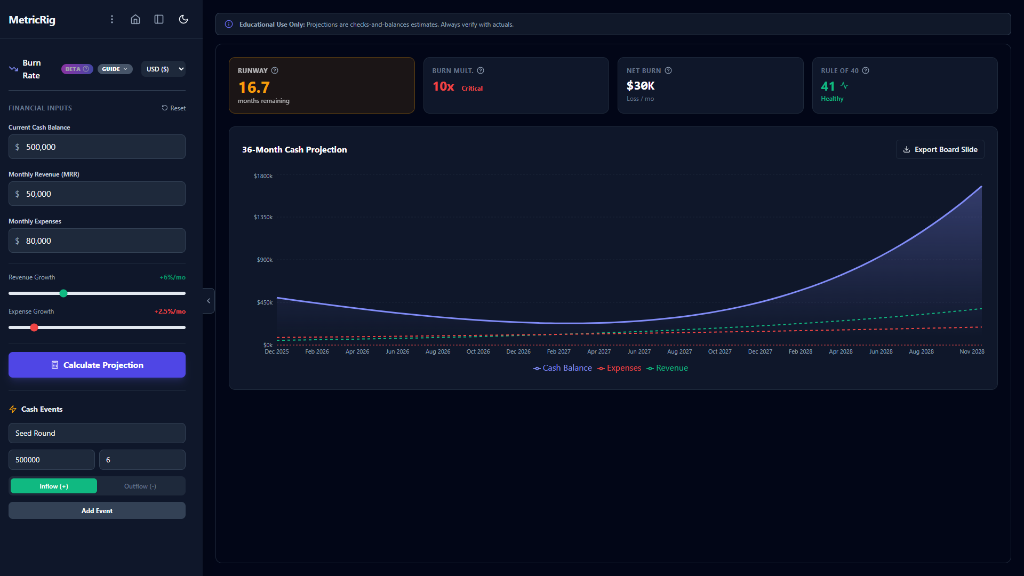
Most SaaS companies can reduce monthly net burn by 15–30% without a single layoff by auditing software subscriptions, renegotiating vendor contracts, converting variable costs to usage-based structures, and optimizing cloud infrastructure spend. For a company burning $400,000/month, a 20% reduction saves $80,000/month — adding nearly 2 additional months of runway on a $5M cash balance without touching the team. The levers are real, material, and executable in 30–90 days. Use the free Startup Runway Calculator at metricrig.com/finance/burn-rate to model what each reduction does to your zero-cash date before and after each change.
Data analytics SaaS companies are valued at 6x to 14x ARR in 2026, depending on growth rate, gross margin, net revenue retention, and market category. High-growth analytics platforms (growing 40%+ year-over-year) with strong NRR above 120% command the upper end of that range, while slower-growth or category-commoditizing businesses trade closer to 5-7x. The median public data analytics SaaS company trades at approximately 8-9x NTM revenue as of mid-2026, down from the 18-25x peaks of 2021 but materially recovered from the 5-6x trough of late 2022 and early 2023. Private company valuations typically apply a 20-35% illiquidity discount to comparable public multiples.
The true cost of a chargeback for a merchant in 2026 is not just the disputed transaction amount — it is the lost revenue, the original processing fees, the chargeback fee ($15–$100 per dispute depending on processor), the internal labor cost to respond ($25–$50 per dispute in staff time), and the inventory cost of goods that cannot be recovered. Research from Chargebacks911 estimates the total loaded cost of a single chargeback at $2.40–$3.60 for every $1.00 of disputed transaction value, meaning a $50 chargeback costs the merchant $120–$180 in total economic impact. Merchants with chargeback rates above 1% of monthly transactions risk processor termination and Visa/Mastercard monitoring programs, making chargeback management a critical financial control — not just a customer service issue.
The best free lease vs buy calculators in 2026 are MetricRig's Lease vs Buy Calculator at metricrig.com/finance/lease-vs-buy (no login, NPV-based comparison for equipment and property with tax and depreciation inputs), Bankrate's lease vs buy auto calculator (consumer-focused, free), and the SBA's equipment financing decision worksheet (PDF-based, free). MetricRig's tool is the only no-account NPV calculator that handles both equipment and commercial real estate scenarios with adjustable discount rates, tax shield from depreciation, and lease payment tax deductibility — the three variables that most spreadsheet-level comparisons omit. The correct framework for any lease vs buy decision is net present value: a lease is financially preferred when the NPV of all lease payments plus the NPV of foregone residual value exceeds the NPV of the purchase price plus financing costs minus the NPV of tax benefits. In practice, buying is almost always better for assets held longer than 5–7 years; leasing is almost always better for assets that will be replaced within 3 years due to technology obsolescence.
The discount rate in a SaaS LTV calculation accounts for the time value of money — a dollar of gross profit received in year 3 is worth less than a dollar received today — and is typically set between 8% and 20% depending on the company's cost of capital, risk profile, and stage. The discounted LTV formula is: LTV = (ARPU x Gross Margin %) / (Churn Rate + Discount Rate), where churn rate and discount rate are both expressed as monthly rates. Applying a 10% annual discount rate (0.83% monthly) to a SaaS business with $500 monthly ARPU, 70% gross margin, and 1.5% monthly churn produces a discounted LTV of $14,286 — compared to an undiscounted LTV of $23,333. Investors and boards who use undiscounted LTV systematically overstate unit economics and understate the true payback period required to justify customer acquisition costs.
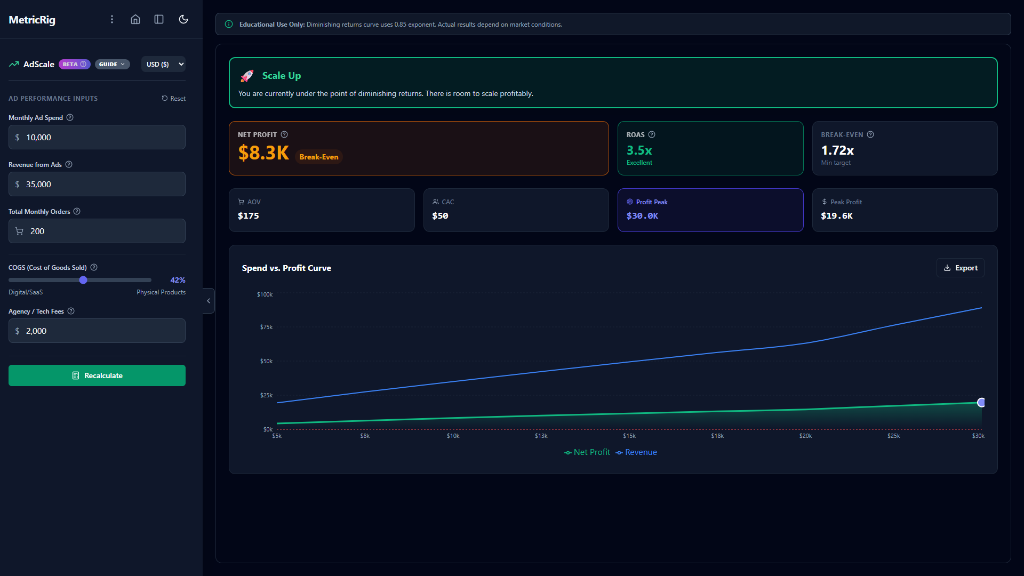
Across Google Ads Search, the average CTR is 4-6%. However, for 'Brand Terms', you should aim for 25%+. A CTR below 2% usually indicates poor ad relevance or bad targeting.