Container Loading

Pallet Capacity for 40ft High Cube

The High Cube is the king of logistics. Here is how to fill it up.

Simulate Your Load

The Short Answer

Standard US Pallets (40x48): Can fit 20 on the floor. If double-stacked, up to 40 total.

Euro Pallets (1200x800): Can fit 23-24 on the floor. If double-stacked, up to 48 total.

The High Cube Advantage

A standard 40ft container is 8ft 6in tall. A 40ft High Cube is 9ft 6in tall.

That extra 12 inches (30 cm) makes all the difference for pallet stacking.

Stacking Math Example

  • Standard Container (Door Height ~2.28m): Two pallets of 1.2m height = 2.4m. FAIL (Too tall).
  • High Cube Container (Door Height ~2.58m): Two pallets of 1.2m height = 2.4m. PASS (Fits easily).

*Note: Always allow ~5-10cm clearance for forklift lifting.

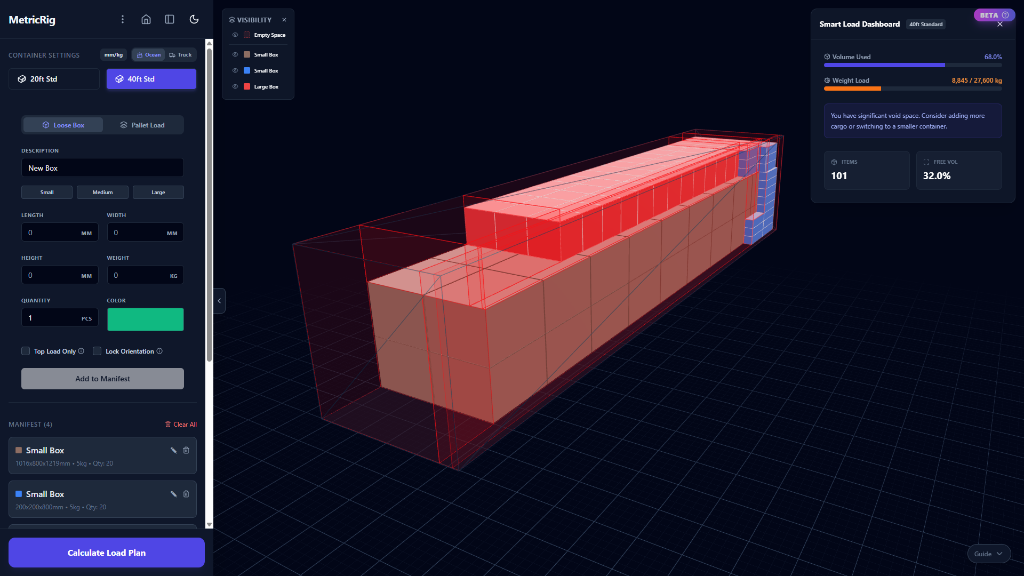
Verify Your Stack in 3D
Privacy First • Data stored locally
MetricRig Partner

Recommended:Get $30 Off your first order! Source industrial equipment and warehouse supplies from verified global manufacturers.

Get $30 Off at Alibaba

Weight Limit Warning

Just because you can fit 40 pallets doesn't mean you can ship them.

The payload limit for a 40ft HC is usually around 26,500 kg (58,400 lbs).

  • Scenario A (Textiles/Clothing): 40 pallets x 200kg = 8,000kg. SAFE. Perfect for High Cube.
  • Scenario B (Beverages/Machinery): 20 pallets x 1,200kg = 24,000kg. FULL. You cannot double stack because you hit the weight limit on the first layer.

Don't Get Stuck at the Port

Use our 3D loader to check weight distribution and axle loads.

Start Loading

Glossary

High Cube (HC)A container that is 9'6" tall. Ideal for voluminous cargo.
Standard (DV/GP)Dry Van / General Purpose. 8'6" tall.
PayloadThe actual weight of the cargo allowed inside the container (excluding the container's own weight).
Tare WeightThe weight of the empty container (~3,900 kg for a 40ft HC).

Frequently Asked Questions

The floor capacity is 20 Standard US Pallets (40x48 inches). However, a High Cube container provides an extra foot of height (9'6' tall vs 8'6'), which often allows for double-stacking. If you can double-stack, the capacity jumps to 40 Pallets.
The floor capacity is 24-25 Euro Pallets (1200x800mm), depending on your loading pattern. If double-stacked, you can fit 48-50 Euro Pallets, provided you stay within the maximum weight limit (~26,500 kg).
No. A High Cube (40ft HC) has the exact same floor dimensions as a Standard 40ft (40ft DV). The difference is purely vertical. It is 1 foot taller. It is ideal for light, bulky cargo that needs stacking height.
The door height of a 40ft HC is roughly 2.58m (101 inches). If you double-stack, the combined height of two pallets (including the wood) must be safely under 2.55m to account for forklift tilt.
Usually, the price difference is negligible or zero. Shipping lines often price them identically because they occupy the same slot on the ship. Always ask for a High Cube even if you don't think you need it, as it gives you loading flexibility.

Related Topics & Tools

Cheapest Way to Ship Heavy Items in 2026

For shipments between 70 and 150 lbs, regional carriers like OnTrac, LSO, and Spee-Dee consistently undercut UPS and FedEx ground rates by 15–35% in their service territories. Shipments above 150 lbs should almost always move via LTL freight rather than parcel — the per-pound rate for LTL drops to $0.08–$0.18/lb versus $0.45–$0.90/lb for parcel carriers on heavy packages. Dimensional weight is the hidden cost driver for heavy-but-bulky items: a 75-lb package measuring 24x24x24 inches bills at 166 lbs under FedEx and UPS's 139 divisor, nearly doubling your cost. Use the MetricRig DIM Weight Rig at /logistics/dim-rig to calculate your billable weight before choosing a carrier.

Read More

Freight Class 300, 400, 500: What Ships at High Classes?

Freight Classes 300, 400, and 500 are the three highest — and most expensive — tiers in the National Motor Freight Classification (NMFC) system, assigned to shipments with very low density: Class 300 covers products with 2–3 lbs per cubic foot (PCF), Class 400 covers 1–2 PCF, and Class 500 covers anything below 1 PCF. Common examples include assembled wood furniture and model boats (Class 300), deer antlers (Class 400), and ping pong balls or gold dust (Class 500). Because LTL rate cards scale sharply with class number, the difference between Class 200 and Class 300 can represent a 40–70% increase in freight cost per hundredweight on the same lane. Accurate density measurement and proper packaging are the primary levers for reducing high-class freight costs.

Read More

10 Free Ecommerce Shipping Tools for Sellers in 2026

The best free ecommerce shipping tools in 2026 cover five functions: discounted label printing, multi-carrier rate shopping, DIM weight calculation, shipment tracking, and returns management. Pirate Ship remains the only fully free label printing platform with no monthly fee and no per-label charge, offering USPS Commercial Plus rates (up to 89% off retail) and UPS discounted rates at zero cost. Shippo's free tier supports 30 labels per month with multi-carrier access. For DIM weight calculation across all major carriers simultaneously, MetricRig's free DIM Weight Rig at /logistics/dim-rig runs unlimited calculations with no account required. Combined, the ten tools in this list cover every core shipping workflow for sellers at any volume from their first shipment to 500+ orders per day.

Read More

How to Reduce LTL Freight Costs: 7 Tactics for 2026

LTL freight rates in 2026 average $0.17-$0.35 per pound depending on freight class, lane, and carrier, with general rate increases (GRIs) adding 5-8% annually across major carriers including FedEx Freight, XPO, Olds Dominion, and Saia. The seven highest-impact tactics for reducing LTL costs are: increasing cargo density to lower freight class, eliminating misbilling through accurate measurements, negotiating FAK agreements, right-sizing packaging, shifting volume to capacity-hungry regional carriers, consolidating LTL into volume LTL or partial truckload, and auditing carrier invoices for overcharges. Use the Freight Class Calculator at metricrig.com/logistics/freight-class to calculate your density and find the most favorable defensible freight class for every shipment.

Read More

6 Free Ocean Freight Rate Tools for Importers in 2026

The best free ocean freight rate tools for importers in 2026 are Freightos Baltic Index (spot rate benchmarking), Flexport Spot (instant FCL and LCL quotes), iContainers (multi-carrier rate comparison), Portchain (contract vs spot analytics), Xeneta Free Tier (rate trend data), and MetricRig's 3D Container Loader (load planning and CBM optimization before booking). Spot rates on the Trans-Pacific route from Shanghai to Los Angeles in 2026 range from $1,400-$2,800 per 40ft container depending on carrier, timing, and volume — down significantly from the 2021-2022 peak of $10,000-$15,000. Use the 3D Container Loader at metricrig.com/logistics/container-loader to maximize your CBM utilization and reduce the number of containers you need before requesting a rate quote.

Read More

Ocean Shipping Carbon Emissions Per Container

A standard 20-foot container (1 TEU) on a major Asia-to-US transpacific route emits approximately 1.5 to 2.0 metric tons of CO2 equivalent (CO2e) per voyage, while a 40-foot container (2 TEU) emits roughly 3.0 to 4.0 metric tons CO2e. The exact figure depends on vessel size, cargo weight, and route distance — larger vessels emit less per TEU because efficiency scales with ship size. Emissions intensity for ocean freight averages around 10 to 15 grams of CO2 per tonne-kilometer (gCO2/tkm), making sea freight 10 to 20 times cleaner per unit than air freight at 500 to 600 gCO2/tkm. Use the MetricRig Container Loader at metricrig.com/logistics/container-loader to determine your actual cargo load per container and feed that into your carbon calculations.

Read More