Digital Marketing

Can I fit a 26ft truck load into a 20ft container?

Read the complete guide below.

Launch Calculator

The Short Answer

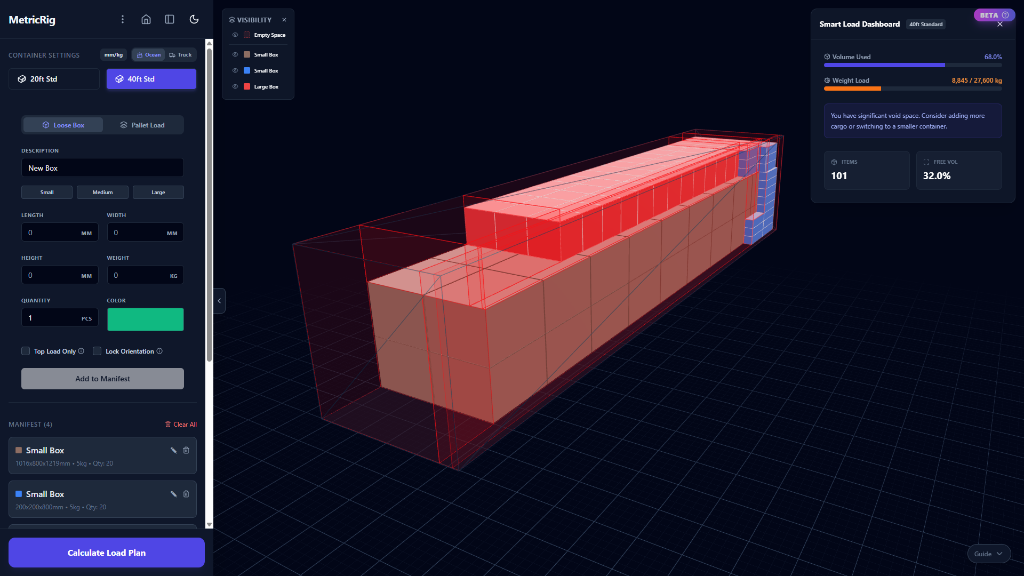
Usually no. A standard 26ft moving truck has roughly 1,600-1,700 cubic feet of cargo space. A 20ft shipping container has only 1,172 cubic feet. If your truck is fully loaded, you will have ~30% overflow.

Comparing the Capacities

This is the most common mistake in international relocation: assuming "big truck" equals "big container." A standard 26ft rental truck (like those from U-Haul or Penske) is designed for domestic moves with generous dimensions. Its box is typically 26ft long, 8ft 1in wide, and 8ft 1in high, yielding approximately 1,700 cubic feet of volume (including the "Mom's Attic" space above the cab).

In contrast, a standard 20ft ISO shipping container is built for stacking strength, not volume. Its internal dimensions are roughly 19ft 4in long, 7ft 8in wide, and 7ft 10in high. The total internal capacity is capped at 1,172 cubic feet (33.2 CBM).

The math is unforgiving: 1,700 > 1,172. If you have a full 26ft truck, you have 528 cubic feet of "excess cargo"—that's equivalent to leaving an entire Master Bedroom suite (King bed, dresser, 2 nightstands, armoire, and 10 large boxes) on the curb.

Furthermore, rental trucks have thin, straight walls made of aluminum or fiberglass. Containers have corrugated steel walls. The "valleys" of the corrugation add width, but the "peaks" subtract it. You effectively lose another 2-3 inches of usable width when trying to load wide furniture like sofas, further reducing the practical capacity compared to the smooth walls of a truck.

Compare Volumes
Privacy First • Data stored locally

The Volume Formula

Volume is calculated as Length x Width x High. For a 26ft truck, the volume is straightforward: 26' x 8.1' x 8.1' ≈ 1,705 ft³. This openness gives you wiggle room for awkward furniture like sofas standing on end. Truck loading is "forgiving" because you can push against the flexible walls slightly, and the rollout door allows ceiling-height loading.

For a 20ft container, the "Corrugation Penalty" applies. The steel walls act like efficient structural columns but eat into your usable width. You functionally have only about 90 inches of width to work with at the pinch points. The door header (the metal bar above the doors) is often 4-6 inches lower than the ceiling, creating a "lip" that makes loading tall items difficult.

The Formula for Disaster: (Truck Volume) - (Container Volume) = Overflow. In this specific matchup, 1705 - 1172 = 533 ft³ overflow. You would need roughly 1.5x 20ft containers to fit the load of one 26ft truck.

Crucially, packing density in a container is often lower. In a rental truck, you might just throw in loose items (lamps, folded chairs) at the end. In a container going across the ocean, **every single item** must be boxed and wrapped to withstand 30 days of rolling waves. This wrapping adds bulk—sometimes increasing displacement by 15-20%.

MetricRig Partner

Recommended:Get $30 Off your first order! Source industrial equipment and warehouse supplies from verified global manufacturers.

Get $30 Off at Alibaba

Moving Day Reality Check

Consider the case of a family moving from Texas to Germany. They loaded their 4-bedroom house into a 26ft Penske truck, packing it "tight to the door." They ordered a single 20ft container for the ocean freight segment to save money. They assumed "a truck is a truck."

On loading day, the crew managed to fit the boxes, the beds, and the dining table. But as they reached the halfway point, realized the 20ft container was full. The sectional sofa (100 ft³), the antique piano (60 ft³), and 40 large book boxes (120 ft³) were left on the driveway.

They were forced to panic-buy a second 20ft container at spot rates ($4,500 extra) or sell the remaining goods for pennies. A single 40ft container (2,389 ft³) would have swallowed the entire load with room to spare for only $1,000 more than the 20ft. The logic of "saving money with a smaller container" backfired, costing them $3,500 more in net logistics spend.

The lesson: If your rental truck is more than 60% full, you need a 40ft container. Do not gamble with a 20ft unless you are willing to leave furniture behind.

Strategic Planning for Moves

If you are moving from a large truck to a container, you have two strategic options: Purge or Upgrade.

The Purge Strategy: If you must use a 20ft container, visualize "cutting off the last 7 feet" of your rental truck. Everything behind that invisible line is garbage. Sell the big furniture. Donate the books. Ship only high-value, sentimental items. Measure exactly 1,000 cubic feet of goods and stop.

The Upgrade Strategy: Just book a 40ft High Cube container. It offers 2,694 ft³ of space—more than enough to swallow a full 26ft truck (1,700 ft³) plus a mid-sized SUV (approx 450 ft³). The price difference between shipping a 20ft and a 40ft container is often surprisingly small relative to the total move cost. In 2024 rates, a US-Europe 20ft might be $3,000 while a 40ft is $4,200. That extra $1,200 buys you double the space.

Another option is Transloading. Drive your 26ft truck to a consolidation warehouse. They can palletize your goods and ship them LCL (Less than Container Load). This is efficient if you have exactly 1,300 cubic feet—too big for a 20ft, too empty for a 40ft. You pay per CBM.

MetricRig Partner

Recommended:Get $30 Off your first order! Source industrial equipment and warehouse supplies from verified global manufacturers.

Get $30 Off at Alibaba

Actionable Steps

1. Use the "Box Rule": Don't count bedrooms. Count boxes. A 20ft container fits roughly 200 medium boxes and basic furniture. A 26ft truck fits 300+ boxes. If your inventory list has more than 200 items, verify carefully.

2. Measure the Door: Rental trucks have roll-up doors that give full height clearance. Containers have heavy steel swing doors with a header bar that lowers the entrance height to roughly 7ft 6in. Tall armoires might not fit upright unless tilted.

3. Calculate Usable Volume: Assume only 85% of the container volume is usable due to inefficient "Tetris" packing. 1,172 ft³ * 0.85 = ~1,000 ft³ of real cargo space. Professional packers can hit 90-95%, but amateurs usually hit 75-80%.

4. Check the Ramp: Rental trucks have low decks and built-in ramps. Containers sit on chassis 4 feet (1.2m) off the ground. You cannot walk a sofa into a container without a loading dock or a massive external ramp rental. Factor this into your loading day plan.

Don't Get Stuck on Moving Day.

Calculate your exact cubic footage needs instantly.

Calculate Volume

Frequently Asked Questions

Typically a 1-2 bedroom apartment (approx 400-600 sq ft loaded). If you have a fully furnished 3-bedroom house, a 20ft container is almost certainly too small.
Technically yes, but it leaves very little room. A typical car takes up 50-60% of the floor space. You would only have space left for a studio apartment's worth of boxes.
Rarely. A 20ft container can hold ~44,000 lbs. A fully loaded 3-bedroom household usually only weighs 8,000-12,000 lbs. Volume (CBM) is the constraint, not weight.
No. Ocean freight for a 40ft is often only 30-50% more than a 20ft. Terminal handling charges are similar. For moving, the 40ft is almost always the better value per cubic foot.
No. 53ft trailers are domestic US/Canada equipment. They do not fit on container ships. You must transload (unload and reload) everything into 40ft ISO containers at the port.

Disclaimer: This content is for educational purposes only.

Related Topics & Tools

Average Ecommerce Shipping Cost Per Order in 2026

The average ecommerce shipping cost per order in 2026 ranges from $3.50 for lightweight USPS Ground Advantage parcels to $14.00 or more for heavier multi-zone UPS or FedEx Ground shipments. Most mid-market ecommerce businesses pay between $6.50 and $9.00 per order all-in, including fuel surcharges and residential delivery fees. Your actual cost depends on four variables: package weight (actual vs. dimensional), shipping zone, carrier selection, and whether you have negotiated rates. Understanding where you sit relative to these benchmarks is the first step toward bringing your per-order shipping cost under control.

Read More

Days Inventory Outstanding (DIO) Benchmarks for 2026

Days Inventory Outstanding (DIO) measures how many days, on average, a company holds inventory before it is sold. The formula is: DIO = (Average Inventory / Cost of Goods Sold) x 365. In 2026, healthy DIO benchmarks vary significantly by industry — fast-moving consumer goods companies target 20–40 days, while manufacturers of complex equipment may operate comfortably at 60–90 days. A lower DIO generally indicates more efficient inventory management and less capital tied up in unsold stock, but an excessively low DIO can signal stockout risk that costs revenue.

Read More

How to Calculate Full Landed Cost for an Amazon FBA Product

The full landed cost formula for an Amazon FBA product is: Landed Cost = Supplier Cost + Inbound Freight + Import Duty + Prep and Inspection + FBA Fulfillment Fee + FBA Storage Fee + Returns Allowance. FBA fees (referral + fulfillment) alone typically represent 30–40% of the selling price and are often the single largest cost component after the supplier price. For a product selling at $24.99 with a $4.50 supplier cost, the fully loaded landed cost including all FBA fees and an inbound freight allocation commonly reaches $13–$16 per unit, leaving a gross margin of 35–48% before advertising costs.

Read More

DIM Weight for Furniture: How Carriers Bill Large Items

Furniture shipped via FedEx or UPS is billed on dimensional (DIM) weight in almost every case because large, bulky items have a DIM weight that dramatically exceeds their actual weight. Both carriers use a DIM divisor of 139 for domestic ground shipments in 2026, meaning a 60x30x24-inch sofa box has a DIM weight of (60 x 30 x 24) / 139 = 311 lbs — even if the actual sofa weighs only 95 lbs. Add the Oversize surcharge of $435–$525 if length plus girth exceeds 130 inches, and a single sofa shipment can generate a carrier invoice of $500–$900 before reaching the customer's door.

Read More

How to Package Your Product for LTL Freight Shipping

LTL freight packaging must protect your cargo through 4–7 terminal handoffs, multiple forklift lifts, and cross-docking events during transit — far more handling than a single parcel shipment. The minimum requirements are: product on a standard 48"x40" GMA pallet rated to your cargo weight, secured with 4–6 layers of stretch wrap spiraled at least four times per pass, and labeled with a Bill of Lading (BOL) affixed to the longest face of the pallet. Packaging also directly affects your freight class: denser, better-packaged shipments qualify for lower class numbers (Class 50–85) and dramatically lower rates per hundredweight. Use the free Freight Class Calculator at metricrig.com/logistics/freight-class to find your class before booking.

Read More

Working Capital for Inventory How to Calculate It

Working Capital Requirement (WCR) for inventory-driven businesses is calculated as: WCR = Inventory + Accounts Receivable – Accounts Payable. This tells you the net cash your operation needs to keep running — the gap between cash tied up in your supply chain and the financing your suppliers extend. For a business carrying $400,000 in inventory, $80,000 in receivables, and $120,000 in payables, the WCR is $360,000. The fastest way to reduce WCR without external financing is to right-size order quantities using EOQ — use the free calculator at metricrig.com/logistics/eoq to find your optimal order quantity for each SKU.

Read More