100% Client-Side • Your Data Never Leaves Your Browser

Beyond ROAS: Find Your True Profit Peak

Why a 5x ROAS doesn't always mean profit—and how to find the exact ad spend level where your profit peaks before diminishing returns eat your margins alive.

Launch Profit Simulator

How to Use the AdScale Profit Simulator

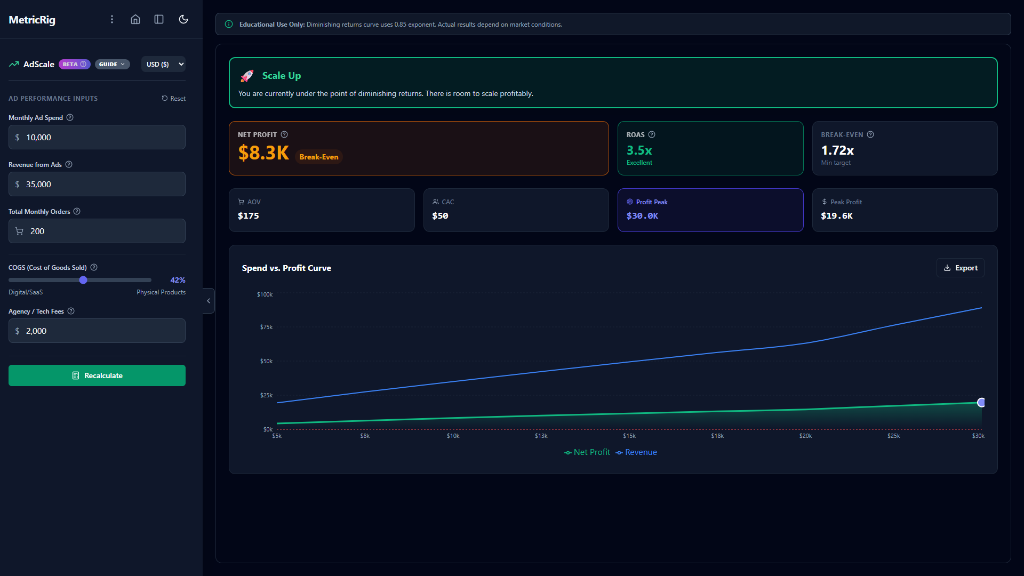
Our AdScale simulator helps performance marketers and e-commerce operators find the optimal ad spend level that maximizes actual profit—not just ROAS. Unlike simple ROAS calculators, this advanced tool models the law of diminishing returns, showing you exactly where scaling becomes unprofitable. Enter your real product margins, current performance metrics, and diminishing return curve assumptions to visualize your true profit landscape in 3D. All calculations run locally in your browser—your margin data and advertising metrics remain completely private.

01

Enter Monthly Ad Spend

Input your current total ad spend across all paid channels (Meta, Google, TikTok, etc.). This becomes the baseline for modeling scale-up scenarios. Use your total spend for customer acquisition campaigns—exclude brand awareness campaigns that aren't directly tied to revenue. The simulator works best with at least $5,000/month where you have meaningful data on performance trends.

02

Input Your Current ROAS

Enter your return on ad spend (revenue ÷ ad spend). If you spend $10K and generate $40K in attributed revenue, your ROAS is 4.0x. Use your blended ROAS across all campaigns, not just top performers—this gives a realistic picture at scale. Check your ad platform dashboards for the last 30-60 days. Be honest; optimistic inputs lead to overly aggressive scaling recommendations.

03

Set Your Product Margins

This is the most critical input. Enter your gross margin after COGS (cost of goods sold). If you sell a product for $100 and it costs $40 to manufacture and fulfill, your gross margin is 60%. Include shipping costs if you offer free shipping. A 4x ROAS on a 30% margin product barely breaks even after fixed costs. The simulator uses this to calculate actual profit, not just revenue.

04

Calibrate Diminishing Returns

Adjust the curve steepness based on your market. Niche products with small audiences see steep curves (20-40% efficiency loss per 50% spend increase). Mass-market products see flatter curves (5-15% efficiency loss). Use historical data from past scaling attempts to calibrate, or start with moderate assumptions and adjust as you gather more data.

05

Read the 3D Profit Curve

The visualization shows profit across different spend levels. Find your "Profit Peak" (maximum profit point), break-even zones, and danger areas where scaling loses money despite positive ROAS. The "ROAS Floor" shows minimum ROAS needed at each spend level to remain profitable—often much higher than advertisers expect.

The simulator will automatically calculate your optimal spend level. You'll see not just where you are today, but the full profit curve as you scale up or down. This prevents the common mistake of scaling past your Profit Peak—where revenue continues growing but actual profit declines due to diminishing returns eating into your margins.

The Profit Paradox: When Great ROAS Loses Money

You've seen the dashboards: glowing 4x ROAS, green arrows everywhere. You celebrate. But at the end of the month, you check your bank account and wonder: where did all the profit go? This is the Profit Paradox—the uncomfortable gap between what ad platforms report and what actually lands in your pocket. Understanding why this happens is the first step to fixing it and building genuinely profitable paid acquisition at scale.

COGS (Cost of Goods Sold) is the hidden destroyer of apparent ROAS success. If your product costs 40% to manufacture and fulfill, that 4x ROAS is really only 2.4x after COGS. At 50% COGS, a 4x ROAS barely covers your product costs—leaving nothing for overhead or profit. Many DTC brands operate at 60-70% COGS, making even "great" ROAS numbers unprofitable when you account for what it actually costs to deliver the product to the customer.

Fixed costs add up quickly and aren't reflected in ROAS calculations at all. Agency fees ($2-10K/month), creative production ($5K+/month), software subscriptions, and team salaries represent constant overhead that doesn't scale with spend. These must be covered by contribution margin before you're truly profitable—and they're completely invisible to your ad platform dashboards.

Platform fees silently erode your margins further. Payment processing takes 2.9% plus $0.30 per transaction. Platform fees (Shopify, Amazon) take another 2-15%. Refunds and chargebacks average 2-5% of revenue. Taxes on revenue (not profit) in some jurisdictions. By the time these are accounted for, your "4x ROAS" might actually be yielding negative contribution margin on every order. Our simulator accounts for all of these factors to show true profitability.

The most dangerous part of the Profit Paradox is that scaling makes it worse. As you spend more, your average ROAS decreases (due to diminishing returns), but your fixed costs remain constant and your variable costs scale linearly with revenue. The combination creates a profit curve that peaks at a specific spend level—then declines, even while revenue continues growing. Chasing revenue growth past this peak actively destroys profit, which is why understanding your actual Profit Peak is so critical for sustainable growth.

The Law of Diminishing Returns in Paid Media

Every ad platform operates as an auction, and auctions follow predictable economic laws. When you spend $10,000, you're buying the highest-intent, lowest-competition impressions first. These are the people actively searching for your product, the retargeting audiences who've already visited your site, the lookalikes most similar to your best customers. Your cost per acquisition (CPA) is low because these audiences convert efficiently. You're skimming the cream off the top of the market—the users already predisposed to buy from you.

Double your spend to $20,000, and you must reach colder, more competitive audiences. You've already captured the easy conversions. Now you're bidding against more competitors for audiences further from purchase intent. Your CPA rises. Each additional dollar of spend yields less revenue than the previous dollar. This is the law of diminishing returns in action—it's not a bug in the algorithm, it's fundamental economics that no amount of optimization can overcome. The best media buyers in the world still face this constraint; they just manage it better.

The shape of your diminishing returns curve depends on your market and competition. Niche products with small total addressable markets see steep curves—you exhaust the interested audience quickly. Mass-market products with broad appeal see flatter curves—there's more audience to reach before efficiency drops. Well-differentiated products with strong brand recognition see flatter curves because people are specifically searching for you, not just your category. Our simulator lets you calibrate your specific curve to see where your Profit Peak actually occurs.

Understanding where you are on the curve changes everything about your strategy. If you're at $10K spend with low CPAs and flat curves, aggressive scaling might be appropriate. If you're at $100K spend with rising CPAs and steep curves, you might be past optimal and should consider pulling back to maximize profit rather than revenue. The 3D visualization in our simulator shows this curve explicitly so you can see exactly where you are, where the peak is, and how much profit you're leaving on the table (or destroying) at current spend levels. Most advertisers operate blind to this curve and make scaling decisions based on gut feel rather than math—which is exactly how six-figure mistakes happen.

Common AdScale Mistakes

1. Optimizing for ROAS Instead of Profit

ROAS tells you revenue per dollar of ad spend, not profit per dollar. A 3x ROAS on high-margin products can be more profitable than 5x ROAS on low-margin products. Always calculate contribution margin (revenue minus COGS minus ad spend) rather than just looking at ROAS. Our simulator shows profit dollars, not ROAS multipliers, because that's what actually matters for your business and bottom line. A $10,000 profit at 2x ROAS beats a $5,000 profit at 6x ROAS every time—but most dashboards hide this reality by emphasizing the flashier-looking but misleading ROAS number.

2. Ignoring Fixed Costs in Scaling Decisions

If you're paying a $5K/month agency fee, you need to generate at least $5K in contribution margin before you're profitable at all. Many advertisers scale spend to "grow revenue" without realizing their fixed costs aren't being covered. The simulator includes fixed costs in profit calculations so you can see your true break-even point, not just your contribution margin break-even. This is especially critical for brands working with agencies, where the monthly retainer can easily exceed $10,000 per month—a cost that's completely invisible in platform-reported metrics.

3. Linear Extrapolation of Results

"If we made $20K profit on $50K spend, we'll make $40K profit on $100K spend." This logic ignores diminishing returns entirely. In reality, doubling spend might only increase profit by 30-50%—or might actually decrease it if you're past your Profit Peak. Always model the curve, never assume linearity. Linear extrapolation is the single most common cause of overspending past profitability. The 3D visualization in our simulator shows exactly how non-linear your profit curve really is.

4. Scaling Before Product-Market Fit

If your repeat purchase rate is low, your LTV:CAC ratio is under 3:1, or your product reviews are below 4 stars, scaling ads just amplifies a broken funnel. You're paying to acquire customers who won't come back and may leave negative reviews, damaging your brand. Fix the product and customer experience first, then scale. Paid media is an accelerant—it works best when there's something worth accelerating. Pouring gasoline on a small fire makes a big fire; pouring gasoline on no fire just wastes gasoline.

5. Not Accounting for Seasonality

Your Profit Peak in January (post-holiday, low competition) is different from your Profit Peak in November (holiday season, peak competition). CPMs can vary 50-100% across the year, dramatically shifting your optimal spend level. Re-run the simulator quarterly to recalibrate your targets based on current market conditions. Advertisers who set annual budgets without accounting for seasonal CPM fluctuations often find themselves overspending during competitive periods and underspending when costs are low—both mistakes that leave profit on the table.

4. Scaling Before Product-Market Fit

If your repeat purchase rate is low, your LTV:CAC ratio is under 3:1, or your product reviews are below 4 stars, scaling ads just amplifies a broken funnel. Fix the product and customer experience first, then scale. Paid media is an accelerant—it works best when there's something worth accelerating.

5. Not Accounting for Seasonality

Your Profit Peak in January (post-holiday, low competition) is different from your Profit Peak in November (holiday season, peak competition). CPMs can vary 50-100% across the year, dramatically shifting your optimal spend level. Re-run the simulator quarterly to recalibrate your targets based on current market conditions rather than using stale assumptions from months ago.

Frequently Asked Questions

What ROAS do I need to be profitable?

It depends entirely on your margins and fixed costs—there is no universal "good" ROAS that applies to all businesses. A business with 70% gross margins might be profitable at 2x ROAS, while a business with 30% gross margins needs 5x+ ROAS just to break even on contribution margin—before fixed costs are factored in. The core formula is: Break-Even ROAS = 1 ÷ Gross Margin. So at 40% margins, you need 2.5x ROAS just to cover product costs. Add fixed costs (agency fees, salaries, software subscriptions, creative production) and you need even higher ROAS to actually generate profit. Our simulator calculates your specific break-even ROAS and shows it directly on the visualization, so you know exactly what "profitable" looks like for your unique business situation rather than relying on generic industry benchmarks that may not apply to your cost structure. The answer is always "it depends"—which is exactly why our simulator exists.

How do I know my diminishing returns curve?

Look at historical data from when you've scaled spend up or down significantly. If you increased spend 50% and ROAS dropped 15%, you can calibrate the curve to match this behavior. Alternatively, use industry benchmarks: e-commerce typically sees 10-20% efficiency loss per 50% spend increase; niche products with smaller audiences see 20-40% efficiency loss; mass-market products with broad appeal see only 5-15% efficiency loss. If you've never scaled significantly, start with moderate assumptions and adjust as you gather data at higher spend levels.

Should I always spend at my Profit Peak?

Not necessarily—it depends entirely on your current business goals and growth stage. The Profit Peak maximizes current-period profit extraction, but if you're optimizing for customer acquisition and lifetime value, you might intentionally spend past the peak to acquire more customers at lower per-customer profit in the short term. Growth-stage companies often deliberately operate above their Profit Peak to build market share and customer base rapidly, accepting lower immediate margins for higher future value and market positioning. Mature businesses optimizing for cash flow and profitability should stay at or below the Peak. Private equity-owned businesses often focus on maximizing cash extraction and should operate at or near the Peak. The key insight is knowing where you are on the curve so you can make an informed, strategic decision about where to operate based on your priorities rather than operating blind. Different stakeholders may have different preferences—VCs want growth, PE wants profit, and the Profit Peak visualization helps you communicate these tradeoffs clearly.

How does attribution affect these calculations?

Attribution windows and methodologies significantly affect reported ROAS in ways that most advertisers underestimate. Platform-reported ROAS typically overstates actual ad-driven revenue by 20-40% because it takes credit for organic and branded search conversions that would have happened anyway. For this simulator, use your best estimate of true incrementality—often 60-80% of platform-reported ROAS depending on your attribution setup and brand awareness levels. If you have incrementality testing data (holdout tests, geo-lift studies), use those results—they're the gold standard. Conservative attribution inputs lead to conservative—and often more accurate—profit projections. It's better to underestimate ROAS and be pleasantly surprised than to overestimate and overspend.

Can I use this for lead generation, not e-commerce?

Absolutely—just substitute revenue with lead value and COGS with cost to serve the customer. For example, if your average closed lead is worth $500 in revenue to your business and your cost to service that customer is $150, your effective "margin" is 70%. Enter ROAS as (lead value × conversion rate) ÷ cost per lead to get your effective return on marketing spend. The same diminishing returns dynamics apply to lead generation: as you scale lead gen campaigns, you inevitably reach increasingly cold audiences with lower intent and conversion rates. The Profit Peak concept is just as relevant for B2B lead gen as for e-commerce—perhaps even more so, since lead quality tends to decline faster than purchase intent as you scale to broader audiences. Many B2B marketers find their optimal spend level is lower than expected because lead quality degrades quickly and sales teams waste time on low-quality prospects. Calculating your true lead value is critical to applying these concepts correctly.

Find Your Profit Peak

Input your real margins and see exactly where scaling becomes unprofitable. Stop guessing, start modeling.

Launch Profit Simulator

Related Topics & Tools

Organic vs Paid Social ROI: Full Comparison 2026

Paid social generates faster, more measurable, and more scalable returns than organic social — but organic social produces higher long-term ROI when content compounds into brand equity, SEO signal, and owned audience assets. For most ecommerce and DTC businesses, paid social delivers a 3–6x ROAS in the short term while organic social takes 6–18 months to generate comparable revenue impact. The correct answer for 2026 is not either/or: companies that treat organic as a brand and trust-building channel and paid as a scalable acquisition channel consistently outperform those who invest exclusively in one. The budget allocation most high-growth brands use is 70–80% paid, 20–30% organic at the growth stage, shifting toward 60/40 as brand equity compounds.

Read More

TikTok Ads CPM Benchmarks for Ecommerce in 2026

TikTok Ads CPM for ecommerce in 2026 averages $9-$10 per 1,000 impressions — approximately 35-40% below Meta's $14.50 ecommerce average and well below Google Display's $12-$18 range. The median CPA for ecommerce purchase conversions on TikTok is $22, with top-quartile advertisers achieving $12-$16 CPA through TikTok Shop's in-app checkout, which delivers 40% higher conversion rates and 25% lower CPAs than link-out to external websites. TikTok's lower CPM, combined with higher organic reach potential and the viral mechanics of the For You Page algorithm, makes it the most cost-efficient paid social channel for ecommerce brands with strong video creative in 2026. Use the Ad Spend Optimizer at metricrig.com/marketing/adscale to model TikTok's CPM, CTR, and conversion rate assumptions against your margin requirements.

Read More

B2B Email Outreach Reply Rate Benchmarks 2026

The average B2B cold email reply rate in 2026 sits between 1% and 5% for generic outreach, while highly personalized, well-targeted sequences routinely achieve 8% to 15%. Reply rate is calculated as: (Replies / Emails Delivered) x 100. Positive reply rate — meaning interested prospects, not just any response — typically runs 20% to 40% of total replies. If your reply rate is below 1%, your deliverability, targeting, or messaging has a fundamental problem that volume alone will not fix.

Read More

SaaS PLG Conversion Funnel Benchmarks 2026

In a product-led growth (PLG) SaaS funnel, top-performing companies achieve a visitor-to-signup rate of 3% to 5%, a signup-to-activation rate of 25% to 40%, and a free-to-paid conversion rate of 2% to 5% for freemium models or 15% to 25% for free trial models. The combined funnel math means that out of 10,000 website visitors, a best-in-class PLG company converts 400 to 500 into signups, 150 into activated users, and 22 to 37 into paying customers. Every percentage point of improvement in activation rate has roughly 5x the revenue impact of the same improvement in visitor-to-signup rate.

Read More

Local SEO vs National SEO: Strategy Guide 2026

Local SEO targets geographically qualified searches — "plumber in Austin" or "best CPA near me" — while national SEO competes for broad, non-location-modified terms at scale. Local SEO typically costs $500 to $2,500 per month and produces leads within 60 to 90 days for businesses with a physical presence or defined service area. National SEO programs range from $3,000 to $25,000 per month and require 9 to 18 months before generating meaningful organic traffic in competitive markets. The right strategy depends on whether your customers are local buyers or any-geography buyers — that single variable determines everything else.

Read More

Zero-Click Searches: What Percentage in 2026?

Approximately 58% to 65% of Google searches in 2026 result in zero clicks — meaning the user's query is resolved on the search results page itself without visiting any external website. This figure has grown from roughly 50% in 2021 as Google has expanded featured snippets, knowledge panels, AI Overviews, and other SERP features that answer queries directly. On mobile devices, zero-click rates reach 70% to 75% due to the prominence of Google's direct answer features on smaller screens. Informational queries have the highest zero-click rates (75% to 85%), while transactional queries have the lowest (20% to 30%), making commercial-intent content the most protected category for organic traffic in the AI era.

Read More